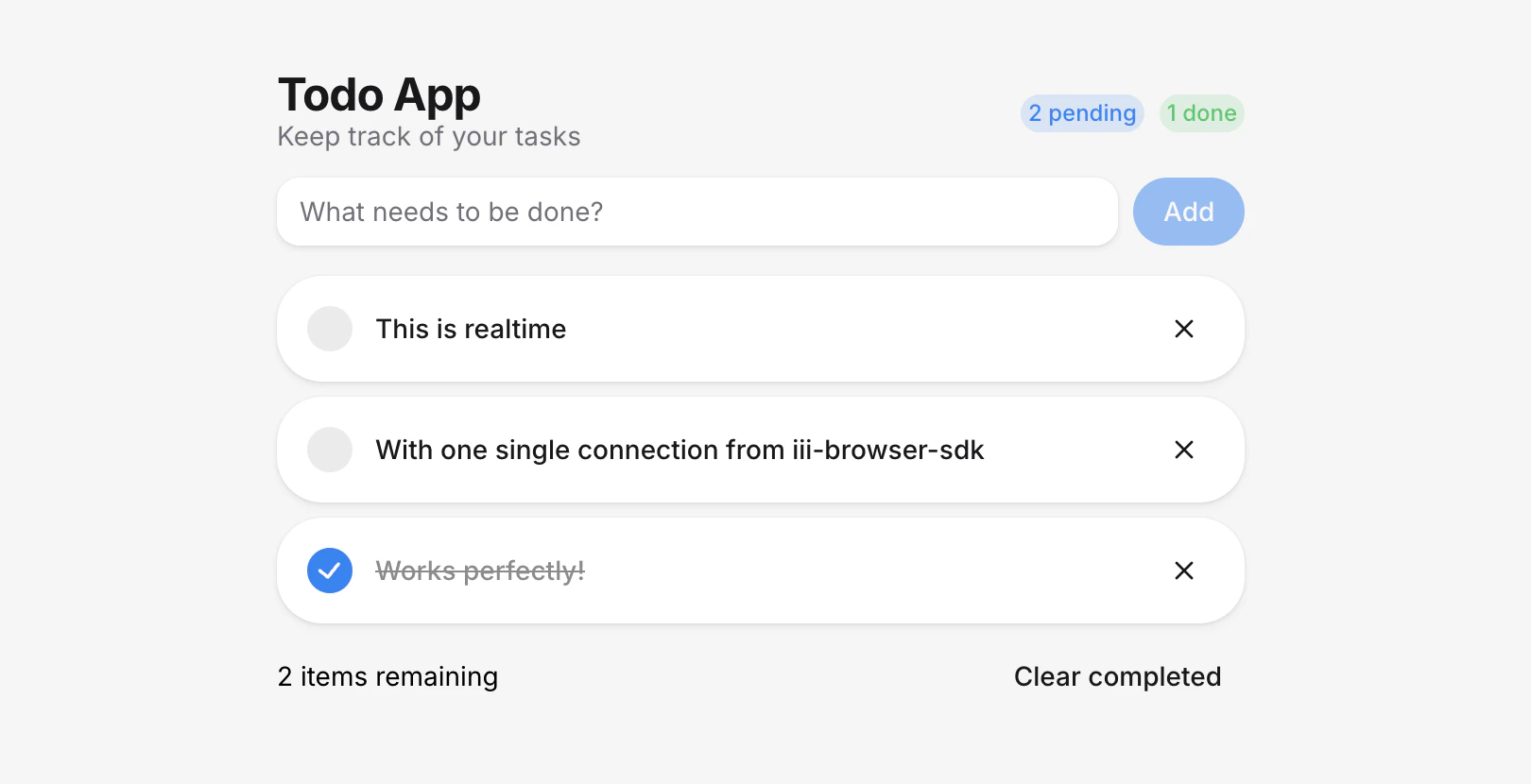
This example builds a full-stack todo app where the browser connects to the iii engine over a single WebSocket. That one connection handles function invocations (create, toggle, delete, list) and delivers real-time stream change events back to the UI — no polling, no separate event channel.

Engine configuration

The iii-config.yaml defines the engine modules:
iii-config.yaml
modules:
  - class: modules::worker::WorkerModule
    config:
      port: 49134

  - class: modules::worker::WorkerModule
    config:
      host: 0.0.0.0
      port: 3111
      rbac:
        auth_function_id: todo-project::auth-function
        expose_functions:
          - match("todos::create")
          - match("todos::list")
          - match("todos::get")
          - match("todos::delete")
          - match("todos::toggle")

  - class: modules::shell::ExecModule
    config:
      exec:
        - pnpm dev

  - class: modules::stream::StreamModule
    config:
      port: 3112
      host: 0.0.0.0
      adapter:
        class: modules::stream::adapters::KvStore
        config:
          store_method: file_based
          file_path: ./data/stream_store
ModulePortPurpose
WorkerModule49134Internal port. The API worker connects here to register functions.
WorkerModule (RBAC)3111Public-facing port. The browser connects here. RBAC controls which functions are exposed and runs an auth function on every new connection.
ExecModuleRuns pnpm dev to start the API worker process.
StreamModule3112Manages stream state with a file-based KvStore adapter. The engine routes stream::get, stream::set, stream::delete, and stream::list to this module.
The RBAC configuration on port 3111 references todo-project::auth-function and explicitly lists the five functions the browser is allowed to call. See Worker RBAC for the full reference.

Backend

Worker setup

The API worker connects to the engine’s internal port and exports a shared logger:
src/iii.ts
import { Logger, registerWorker } from 'iii-sdk'

export const iii = registerWorker(process.env.III_URL ?? 'ws://localhost:49134', {
  workerName: 'api-worker',
})

export const logger = new Logger()

Auth function (RBAC)

The auth function runs on every new WebSocket connection to the RBAC port. It creates a session ID and uses function_registration_prefix so each browser session gets its own namespace — the engine automatically prefixes function IDs registered by that session, preventing collisions.
src/lib/rbac.ts
import type { AuthInput, AuthResult } from 'iii-sdk'
import { logger } from '../iii.ts'
import { fn } from './decorators.ts'

fn('todo-project::auth-function', async (input: AuthInput): Promise<AuthResult> => {
  const sessionId = crypto.randomUUID()
  logger.info('New session created', { sessionId, ip: input.ip_address })

  return {
    allowed_functions: [],
    forbidden_functions: [],
    allow_trigger_type_registration: false,
    allow_function_registration: true,
    allowed_trigger_types: ['stream'],
    context: { session_id: sessionId },
    function_registration_prefix: sessionId,
  }
})

Stream wrapper

The TodoStream class provides a typed interface over the engine’s built-in stream operations. Each method triggers the corresponding stream::* function:
src/routes/todos.stream.ts
import type {
  DeleteResult, IStream, StreamDeleteInput, StreamGetInput,
  StreamListGroupsInput, StreamListInput, StreamSetInput,
  StreamSetResult, StreamUpdateInput, StreamUpdateResult,
} from 'iii-sdk/stream'
import { iii } from '../iii.ts'

export interface Todo {
  id: string
  title: string
  completed: boolean
}

const mutateArgs = (args: any) => ({ ...args, stream_name: 'todo' })

export class TodoStream implements IStream<Todo> {
  async get(args: Omit<StreamGetInput, 'stream_name'>): Promise<Todo | null> {
    return iii.trigger({ function_id: 'stream::get', payload: mutateArgs(args) })
  }

  async set(args: Omit<StreamSetInput, 'stream_name'>): Promise<StreamSetResult<Todo>> {
    return iii.trigger({ function_id: 'stream::set', payload: mutateArgs(args) })
  }

  async list(args: Omit<StreamListInput, 'stream_name'>): Promise<Todo[]> {
    return iii.trigger({ function_id: 'stream::list', payload: mutateArgs(args) })
  }

  async update(args: Omit<StreamUpdateInput, 'stream_name'>): Promise<StreamUpdateResult<Todo> | null> {
    return iii.trigger({ function_id: 'stream::update', payload: mutateArgs(args) })
  }

  async delete(args: Omit<StreamDeleteInput, 'stream_name'>): Promise<DeleteResult> {
    return iii.trigger({ function_id: 'stream::delete', payload: mutateArgs(args) })
  }
}

export const todosStream = new TodoStream()

Functions

All functions are registered with fn(), a thin wrapper around iii.registerFunction. There are no HTTP routes — the browser calls these functions directly over the WebSocket connection.
src/routes/todos.create.ts
import { fn } from '../lib/decorators.ts'
import { type Todo, todosStream } from './todos.stream.ts'

export const createTodo = fn(
  'todos::create',
  async (req: { title: string }): Promise<Todo> => {
    const id = crypto.randomUUID()
    const result = await todosStream.set({
      group_id: 'todos',
      item_id: id,
      data: { id, title: req.title, completed: false },
    })

    return result.new_value
  },
  { description: 'Create a new todo' },
)

Frontend

Connection

The browser connects to the RBAC port using iii-browser-sdk. This single connection is used for both triggering functions and receiving real-time stream updates:
src/lib/iii.ts
import { registerWorker } from 'iii-browser-sdk'

export const iii = registerWorker('ws://localhost:3111')

Real-time hook

The useTodos hook manages the full lifecycle — initial fetch, live updates, and CRUD operations — all through the same WebSocket connection:
src/hooks/use-todos.ts
import type { StreamChangeEvent } from 'iii-browser-sdk/stream'
import { useCallback, useEffect, useMemo, useState } from 'react'
import { iii } from '../lib/iii'

export interface Todo {
  id: string
  title: string
  completed: boolean
}

export function useTodos() {
  const [todos, setTodos] = useState<Todo[]>([])

  useEffect(() => {
    void iii
      .trigger<Record<string, never>, { items: Todo[] }>({
        function_id: 'todos::list',
        payload: {},
      })
      .then(({ items }) => setTodos(items))

    const funcRef = iii.registerFunction(
      { id: 'ui::on-todo-change' },
      async (input: StreamChangeEvent) => {
        const todo = input.event.data as Todo

        switch (input.event.type) {
          case 'create':
            setTodos((prev) => [...prev, todo])
            break
          case 'update':
            setTodos((prev) => prev.map((t) => (t.id === input.id ? todo : t)))
            break
          case 'delete':
            setTodos((prev) => prev.filter((t) => t.id !== input.id))
            break
        }

        return {}
      },
    )

    const trigger = iii.registerTrigger({
      type: 'stream',
      function_id: funcRef.id,
      config: { stream_name: 'todo', group_id: 'todos' },
    })

    return () => {
      trigger.unregister()
      funcRef.unregister()
    }
  }, [])

  const addTodo = useCallback(async (title: string) => {
    await iii.trigger({ function_id: 'todos::create', payload: { title } })
  }, [])

  const toggleTodo = useCallback(async (id: string) => {
    await iii.trigger({ function_id: 'todos::toggle', payload: { id } })
  }, [])

  const deleteTodo = useCallback(async (id: string) => {
    await iii.trigger({ function_id: 'todos::delete', payload: { id } })
  }, [])

  const clearCompleted = useCallback(async () => {
    const completed = todos.filter((t) => t.completed)
    await Promise.all(
      completed.map(({ id }) =>
        iii.trigger({ function_id: 'todos::delete', payload: { id } }),
      ),
    )
  }, [todos])

  const remaining = useMemo(() => todos.filter((t) => !t.completed).length, [todos])
  const completedCount = useMemo(() => todos.filter((t) => t.completed).length, [todos])

  return { todos, addTodo, toggleTodo, deleteTodo, clearCompleted, remaining, completedCount }
}
The hook does three things on mount:
  1. Fetches the current list by triggering todos::list.
  2. Subscribes to real-time changes by registering a local function (ui::on-todo-change) and binding it to a stream trigger on the todo stream. The engine pushes StreamChangeEvent payloads (create, update, delete) whenever the stream changes.
  3. Cleans up by unregistering both the function and the trigger on unmount.
All CRUD operations (addTodo, toggleTodo, deleteTodo) call iii.trigger with the corresponding function ID. The response arrives over the same connection, and the stream trigger delivers the update to all connected clients.

Key concepts

  • Single connection — The browser opens one WebSocket to the RBAC port. Function calls and real-time stream events flow over the same connection.
  • No HTTP routes — The API worker registers plain iii functions. The browser invokes them directly via iii.trigger. There is no REST layer.
  • RBAC — The engine’s WorkerModule supports auth functions, expose lists, and middleware. This example uses a simple auth function that creates a session. See Worker RBAC for the full reference.
  • Engine-managed streams — The StreamModule handles persistence (file-based KvStore in this example). The API worker reads and writes through stream::* function triggers — no custom stream implementation required.
  • Session isolation — The auth function returns a function_registration_prefix. The engine prefixes every function registered by that browser session, so multiple clients can register ui::on-todo-change without colliding.